Transforming Service Navigation with Agentic AI
Designing an AI concierge that turns ambiguous care needs into clear paths to resolution.
Overview
Concierge Dot is an agentic AI experience designed to help members navigate care from initial need to resolution. It brings together care navigation, provider matching, scheduling, and human support into one guided experience.
My role
I led the end-to-end experience design across AI discovery, interaction strategy, care navigation, provider matching, scheduling and human-in-the-loop support.
I also created reusable frameworks and interaction patterns that helped the broader organization design AI experiences more consistently.

The challenge
Included Health offers many ways for members to get care, from urgent care and primary care to mental health and external providers. But finding the right option required members to understand our care model first.
Most members don’t have that mental model. They often know what they’re experiencing, but not which service they need.
The vision
Instead of asking members to navigate our services, we wanted Dot to understand what they needed and guide them to the right path.
Bringing the Vision to Life
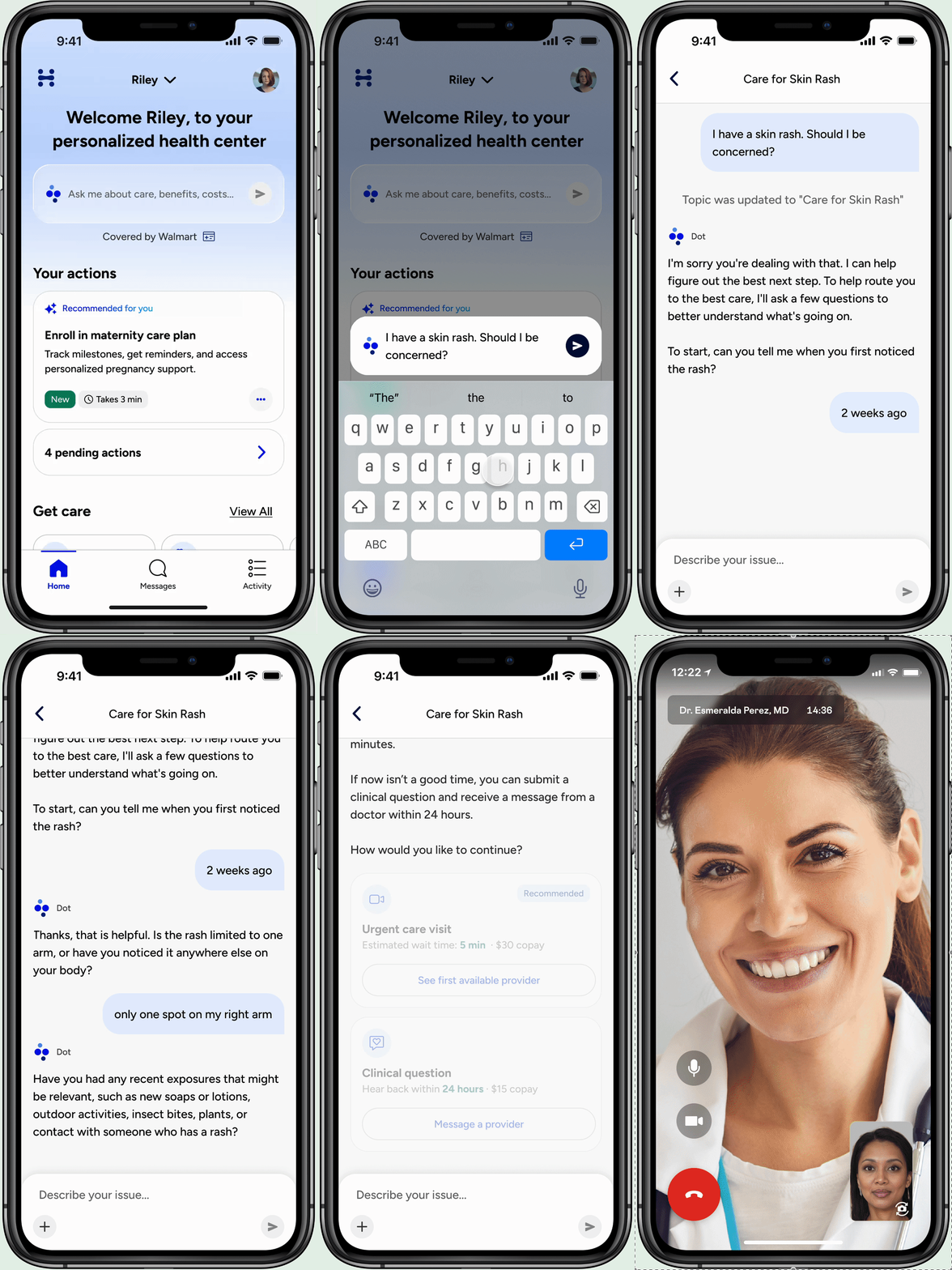
From conversation to care
Dot starts by understanding the member's situation, then translates that context into a recommended care pathway.
It doesn't stop at answering a question - it helps members take the next step.
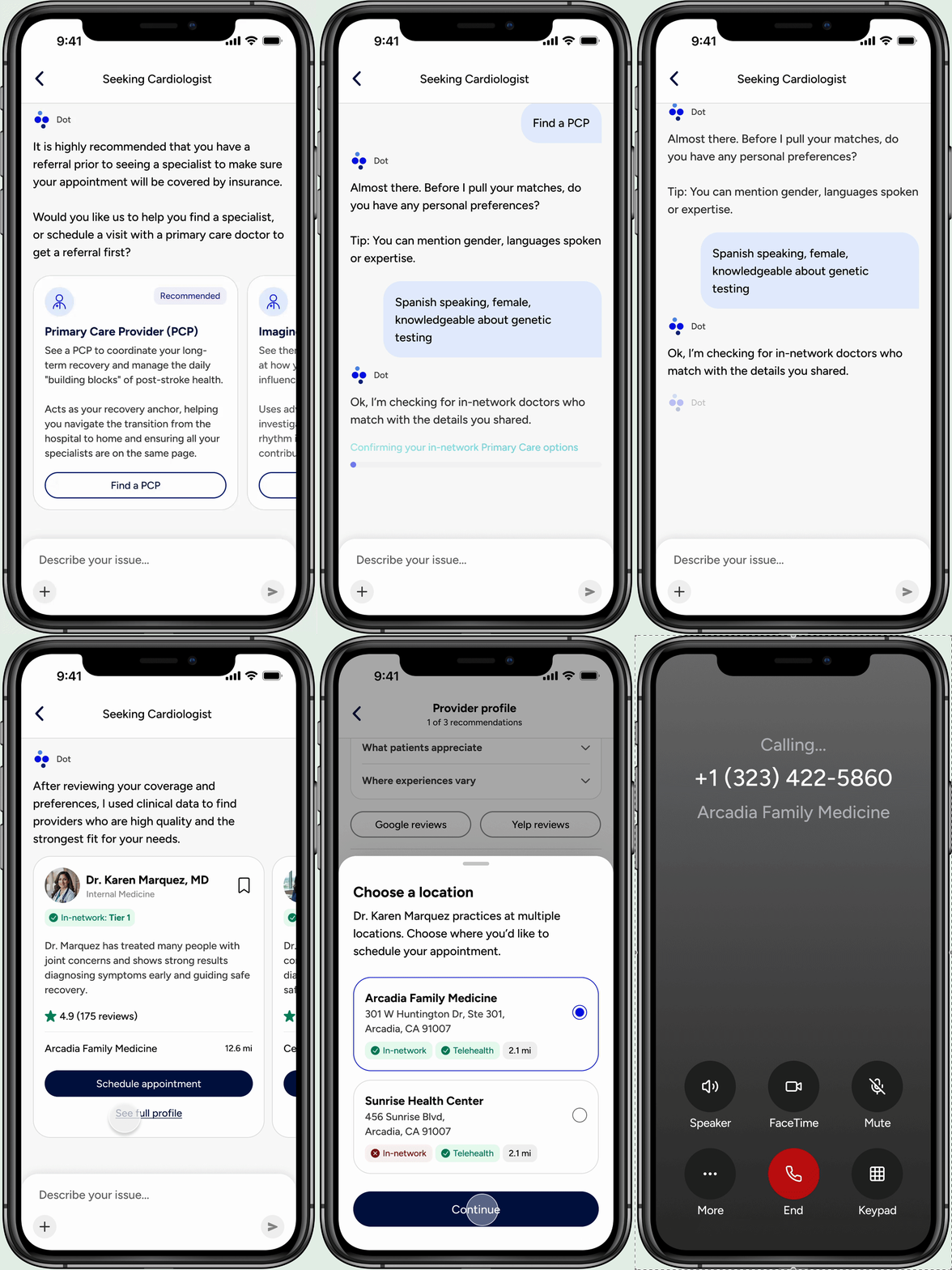
Better-fit provider matching
When external care is needed, Dot collects the context that actually matters, such as location, clinical fit, and preferences and uses our provider data to recommend better-fit options.
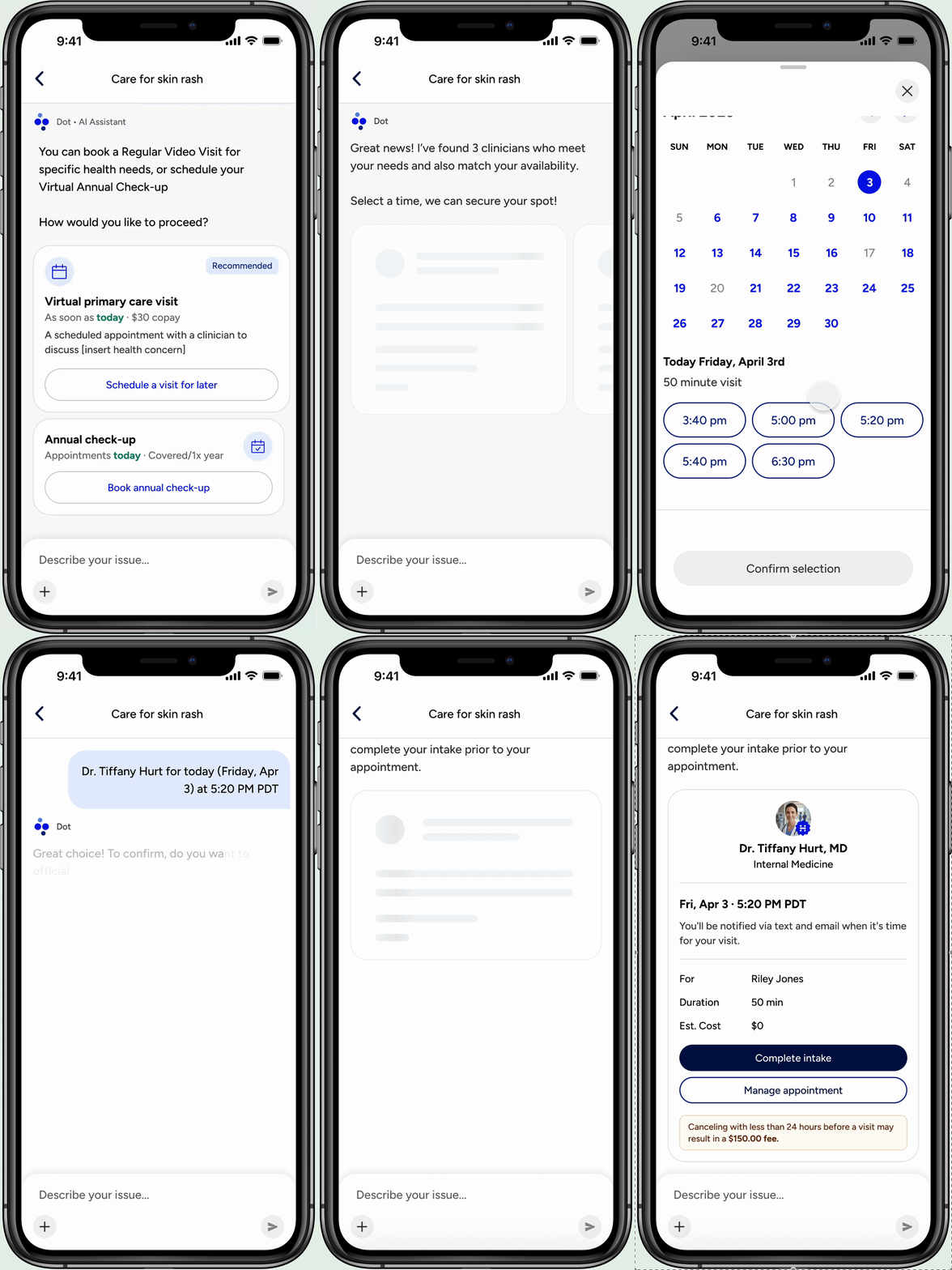
Close the loop with scheduling
For internal care, Dot can carry context into scheduling, recommend appropriate clinicians, surface availability, and help members complete the booking directly.
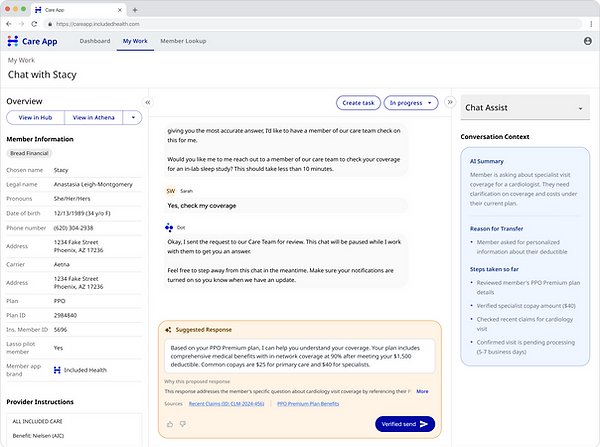
Human-in-the-loop support
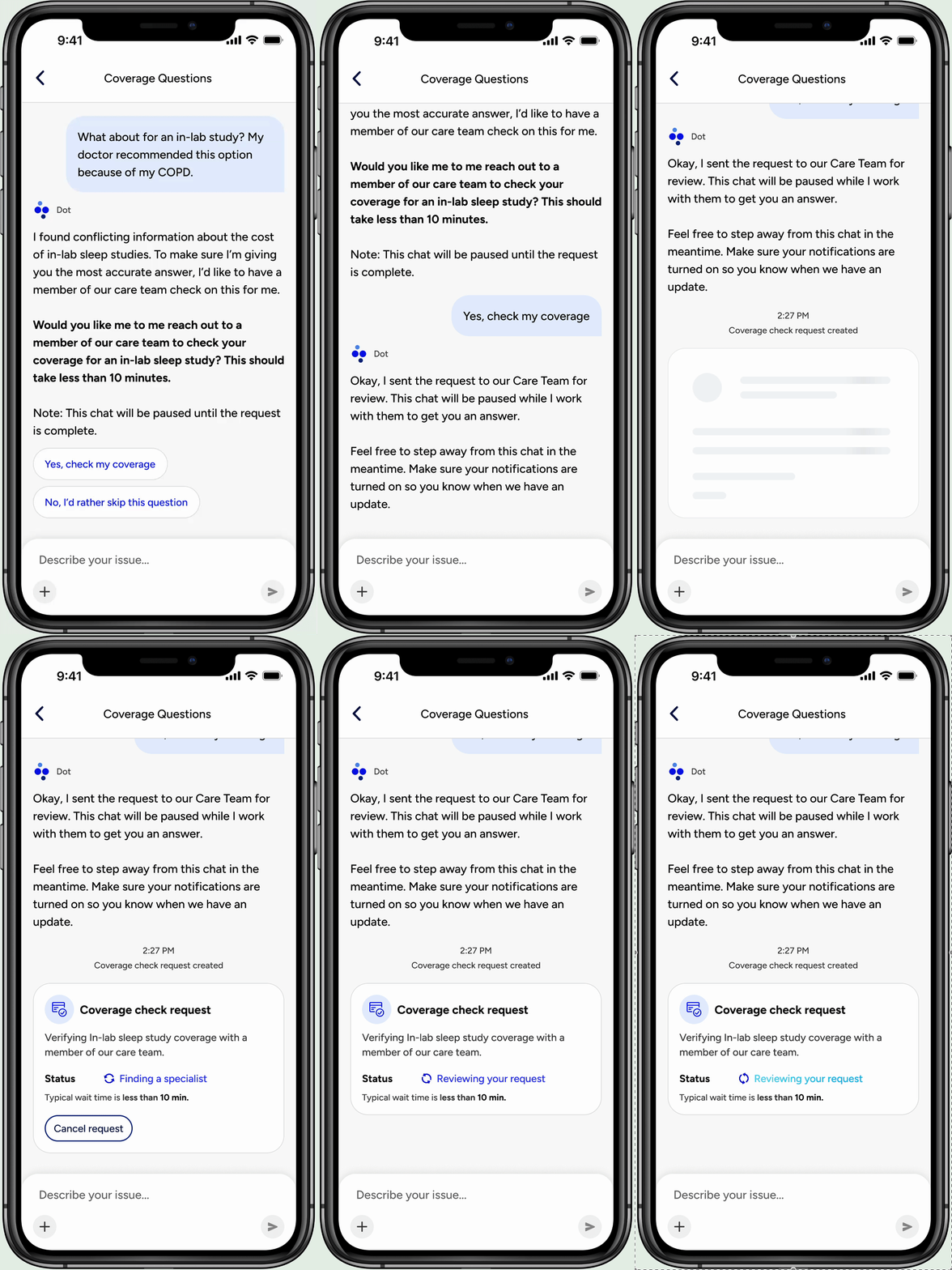
Because healthcare decisions can involve safety, ambiguity, and complex benefits, Dot was never designed as a fully autonomous black box.
When confidence is low, Dot can pause and escalate the request.
The Care Team receives the conversation context, an AI-generated summary, and a suggested response. They apply judgment, resolve the ambiguity, and hand the journey back to Dot.

How we got there
01 - Define the AI before designing the interface
The problem
Our existing product process worked well for traditional features, but AI introduced more fundamental questions that the team was not fully aligned on:
-
Why should this exist beyond “we need an AI experience”?
-
What does success look like from a member’s perspective?
-
And how good is good enough for MVP?
My approach
I created and facilitated a structured AI discovery workshop that helped the team make those decisions before designing the experience. The framework was later adopted as our organization’s Collaboration Cheat Sheet for kicking off AI projects.

STEP 1
Start with the human problem
Instead of asking “How can we use AI?”, I grounded the team in what members were trying to accomplish and where the existing experience was failing them.
STEP 2
Define AI's unique role
We identified where AI could outperform traditional UX: understanding messy inputs, contextualizing them against benefits and care options, and carrying context across multiple steps.
STEP 3
Design around real data
We mapped what the system knew, what it partially knew, and what it couldn't reliably know.
That helped us define realistic v1 boundaries, fallbacks, and future platform needs.

STEP 4
Define the human–AI partnership
Using levels of automation, I helped the team establish clear ownership:
-
AI could understand, recommend, and handle well-defined paths.
-
Humans remained responsible for safety-critical, ambiguous, and judgment-heavy decisions.

STEP 5
Design for failure from the start
Uncertainty wasn't treated as an edge case. We designed escalation and recovery as part of the core experience.
STEP 6
Co‑create concepts and used feasibility and desirability to prioritize
I brought cross-functional partners together to generate concepts, then prioritized the strongest directions based on user value and technical feasibility.
From ambiguity to alignment
The workshop moved the team from a vague ambition “let's build an AI experience” to a shared product model for what AI should do, what humans should own, and what a trustworthy v1 could realistically deliver.
The framework was later adopted internally as a Collaboration Cheat Sheet for kicking off AI projects.
02 - Move beyond chat-only AI
The problem
Early concepts leaned heavily toward a chat-only interface.
Chat felt simple and AI-native, but real healthcare journeys quickly exposed its limits.
To make a good recommendation, Dot may need structured information about symptoms, preferences, insurance, or clinical history. Collecting all of that through free text creates long conversations, incomplete answers, and unnecessary cognitive load.
My approach
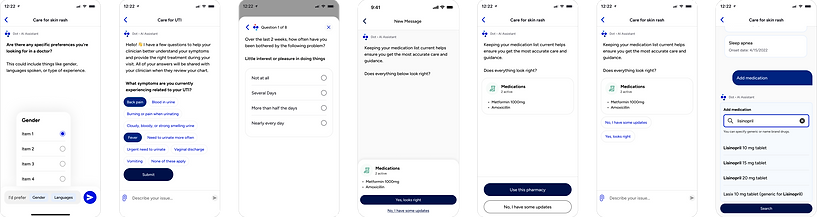
Conversation should be the container, not the interface for every task.
I developed a reusable interaction system where structured UI appears contextually when it is better suited to the task.
STEP 1
Explore the right interaction for each task
I explored a range of interaction patterns and evaluated their tradeoffs across different needs, including speed, accuracy, complexity and flexibility.
This helped me understand where conversation worked well and where structured UI was a better fit.
STEP 2
Turn the patterns into a reusable system
Based on those learnings, I defined a focused set of reusable interaction patterns, with guidance for when each should be used.
Structured UI could now appear contextually whenever it was more effective than conversation.

Key interaction patterns
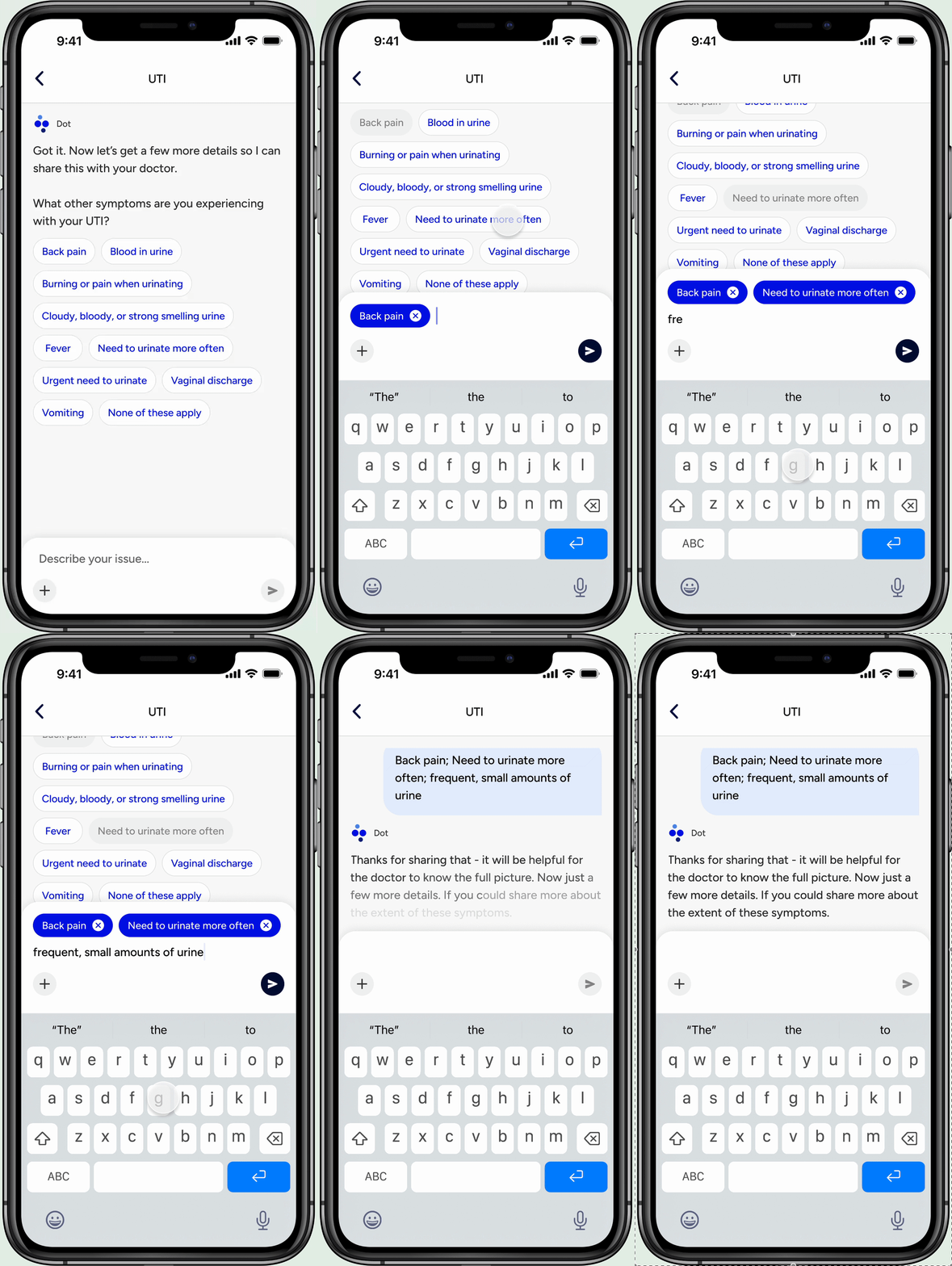
Multi-select chips
Best for small, well-defined answer sets.
Users can quickly provide structured input while still adding nuance in their own words.
Structured enough for the system. Flexible enough for people.
Guided forms with docked AI support
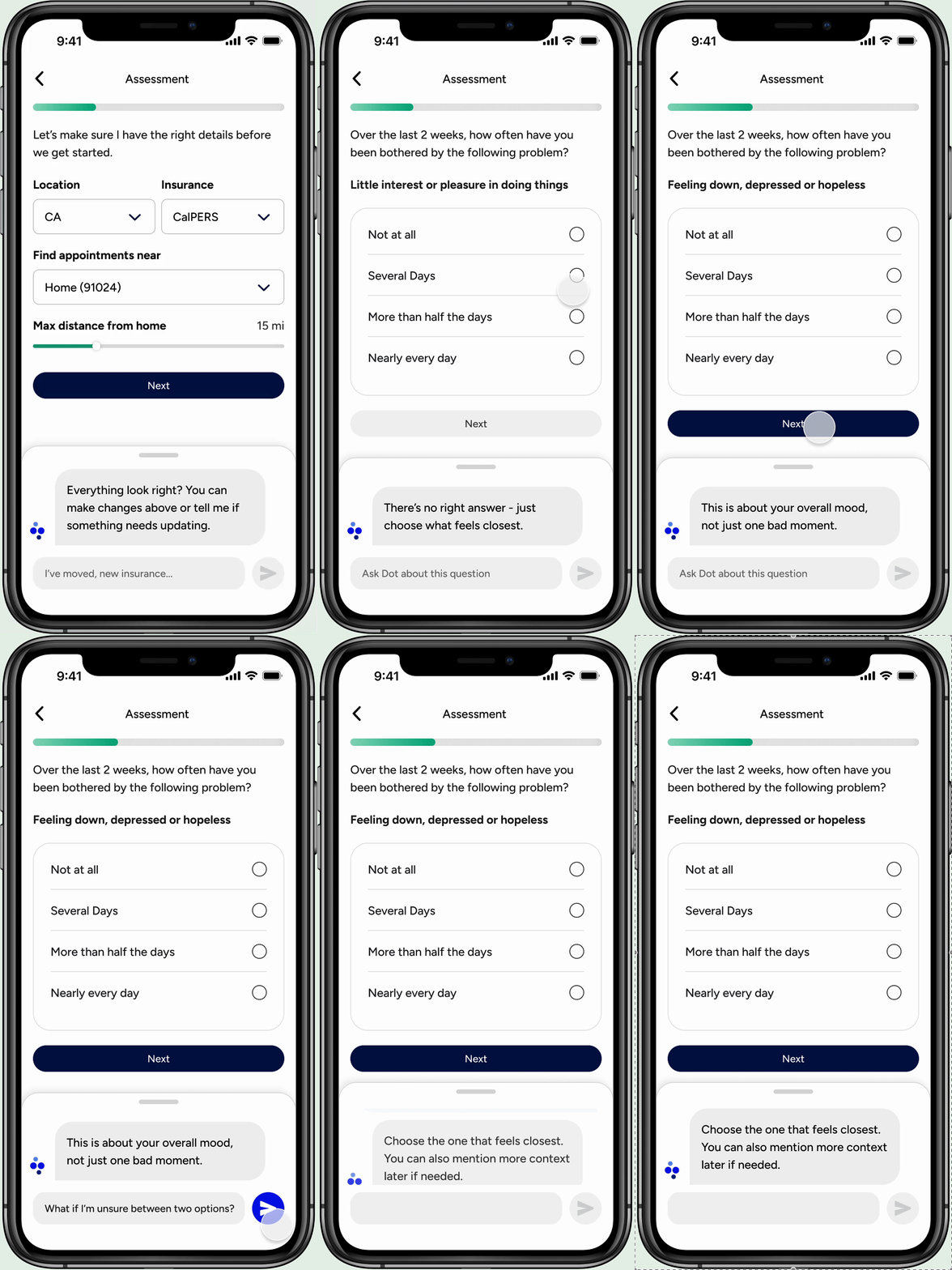
For longer assessments, I combined the efficiency of a structured form with the flexibility of conversational support.
Users can move through straightforward questions quickly, while Dot stays available to clarify anything confusing without interrupting the task.
Impact
12%
faster in Urgent Care task completion
25%
increase in member satisfaction / MSAT
Takeaway
Concierge Dot wasn’t about simply adding AI to an existing experience.
It required us to rethink how users express intent, how the system interprets that intent, how AI and humans work together, and how multiple services can be orchestrated into one clear path to resolution.
The result was not just a conversational AI agent, but a new interaction model for helping users navigate complexity and get to the right outcome.